
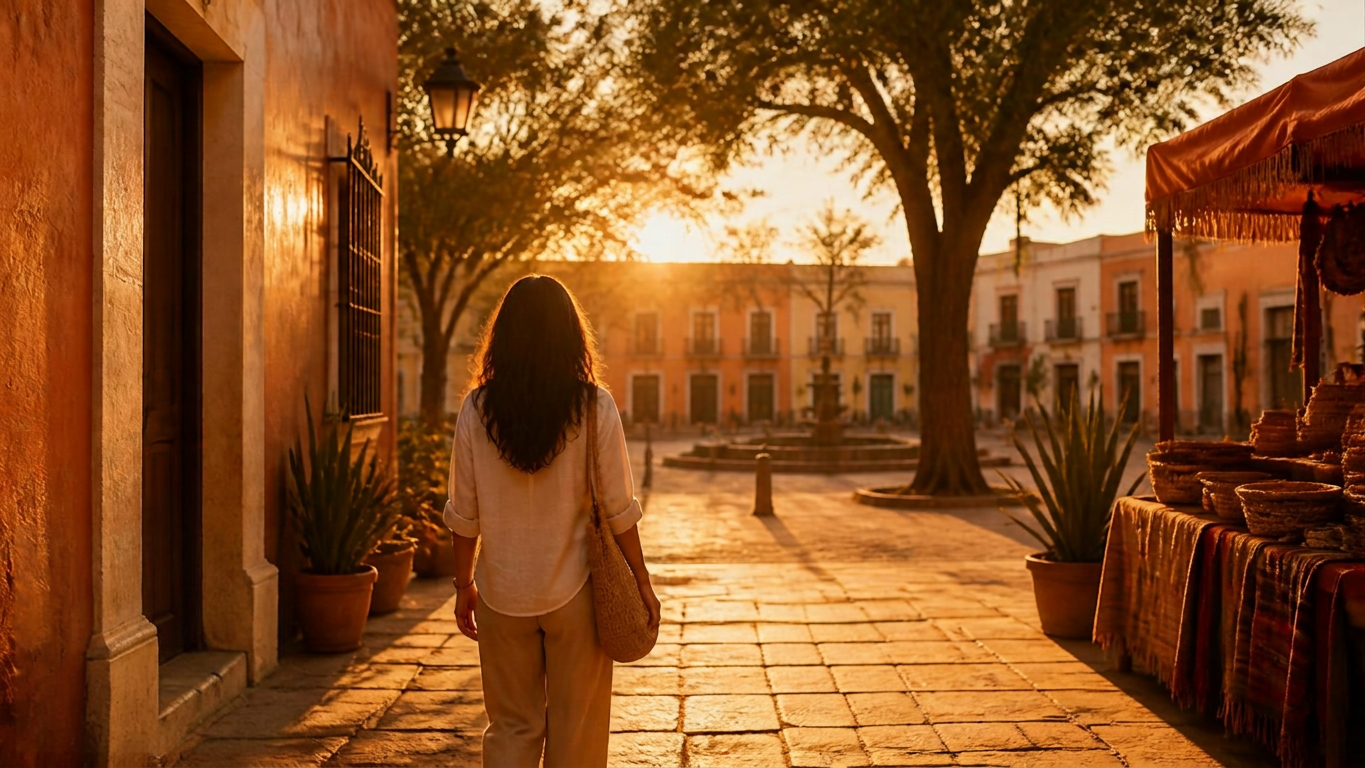

Every city has a place where people actually live — not where they visit, where they build a life. In Mexico City, that place isn’t one neighborhood. It’s a short walk between three of them, each with its own answer to the question this month keeps asking: who’s going to gather at your table once it’s set?
The Vibe: A City Built for Gathering
Mexico City is enormous — one of the largest cities on earth — but the parts of it that matter for building a life are smaller, walkable, and built around exactly the kind of gathering this season is named for. Plazas instead of parking lots. Markets instead of grocery delivery apps. A culture where sitting at a table for three hours is not rude, it’s the point.
The Lay of the Land
Roma Norte is the creative heart of the city — tree-lined boulevards, Art Nouveau architecture, and a food scene that runs from a single life-changing pastry to the best taco you’ve ever had, two blocks apart. It was the aristocratic heart of the city a century ago; today it’s where new ideas get made. Galleries, concept stores, workshops — the sense that culture is being shaped here in real time, not just consumed.
Condesa, just across Avenida de los Insurgentes, is Roma’s chic, wellness-focused sister neighborhood. Its center is Parque México — huge trees, an Art Deco open-air theater, dog walkers at every hour. If Roma is where you go to be seen, Condesa is where you go to slow down: yoga in the park, a loop around Avenida Ámsterdam past Art Deco apartment buildings and neighborhood bookstores, a life built at a gentler pace.
Coyoacán is older, slower, and entirely its own — a pueblo that got absorbed into the city without ever losing its identity. Cobblestone streets. Two plazas instead of one — Jardín Centenario and Jardín Hidalgo — where families and dreamers have gathered for centuries. The Mercado de Coyoacán is where you go to understand the real pulse of the neighborhood: a working market, not a tourist stop, loud and a little chaotic and completely unfiltered.
What a Table Looks Like in Each One
In Roma Norte, your table is built from the city’s creative energy — a dinner that starts at a sit-down restaurant and ends two blocks away at a taco stand, because the lines between “fine dining” and “street food” don’t hold the way they do back home.
In Condesa, your table is the park itself. Parque México functions as the neighborhood’s living room — people read there, fall in love there, walk their dogs there, every single day. If you want to build a gathering practice that doesn’t require four walls, this is where you start.
In Coyoacán, your table is the market. Go to the Mercado de Coyoacán on a Saturday morning, buy what’s actually in season, and you’ll understand more about building a life in this city than any guidebook can tell you. End the day with tostadas from a market stall or churros from a stand in the plaza — a small, specific ritual worth making your own.
Finding Your People
A table needs people around it, and Mexico City has one of the largest and most visible Black communities in the country. You do not have to find it alone.
Start with Brothas & Sistahs In Mexico City, a large, active Facebook group for Black Americans in and around the city. Members share everything from housing questions to meetup announcements, and it is the most active online hub for community here. Join before you arrive. Introduce yourself. Say yes to the first meetup.
Community here also happens in person, not just online. Blaxicocina, a Black-owned soul food restaurant in the city, has become a real gathering spot. And Travel Well with Meckell, a Black-owned travel brand and content platform based in the city, hosts regular live conversations about building a life in Mexico.
Groups and gathering spots change over time. Treat these as a starting point, and ask inside the group what is active now.
November 20: Revolution Day
If you are in the city on November 20, you will feel it. Día de la Revolución turns the city center into a patriotic hub.
The day begins at the Zócalo, the Plaza de la Constitución, where national authorities raise the monumental flag and render honors. The President, the Head of Government of Mexico City, and top military and judicial officials gather to address the nation and review the armed forces.
Then comes the civil-military parade. It traditionally travels from the Zócalo toward Campo Marte or through the major historic avenues. Thousands of members of the Army, Navy, Air Force, and National Guard march in formation, joined by athletes, horse-mounted units in period uniforms, and re-enactors dressed as revolutionary figures like Pancho Villa and Emiliano Zapata. Overhead, the Mexican Air Force flies low, trailing green, white, and red smoke across the sky.
Around the city, the Monumento a la Revolución in Plaza de la República becomes a focal point, with special displays, fountains, and visitors riding its central elevator and exploring its museum. Avenues like Paseo de la Reforma and Avenida Juárez often close to cars on Sundays and holidays, and fill with cyclists, families, and street vendors.
One practical note: the holiday often lands near El Buen Fin, Mexico’s nationwide shopping and discount weekend, so malls and commercial areas get very busy. Plan your errands around it.
What to Verify Locally
Mexico City is a different altitude, a different pace, and a different set of neighborhoods than Quintana Roo, so a few things are worth checking once you’re actually here rather than assuming from afar: which neighborhood fits your budget now versus a year from now, since Roma and Condesa have both gotten more expensive as more people discover them; what the commute looks like between where you’d live and where you’d actually spend your days, since this city is large enough that “nearby” can still mean forty minutes; and what November actually feels like here — it falls in the city’s cooler, drier season, worth knowing before you plan a first visit around it.
The Honest Trade-Offs
None of this comes free. Roma Norte and Condesa are not secrets — they’re two of the most visible, most written-about neighborhoods in the city, and that visibility shows up in rising prices in the most popular blocks. Coyoacán trades convenience for character: it’s further from the center, and its charm is exactly the kind that draws crowds on weekends. If what you want is undiscovered and quiet, none of these three neighborhoods are that. If what you want is a city that already knows how to gather — that builds its daily life around plazas, markets, and tables instead of around isolation — this is one of the best versions of that you’ll find anywhere in Mexico.
A Final Word: Three Tables, One City
You don’t have to choose just one of these neighborhoods before you’ve lived here. Most people who build a real life in Mexico City end up moving between versions of all three — the creative energy of Roma, the slow mornings of Condesa, the market rhythm of Coyoacán — until they find the combination that actually feels like theirs.
Wherever you land first, the table is already there, set by a city that has been gathering people at it for centuries. You just have to pull up a chair.
If this is the kind of city that’s calling you, a Strategy Session or one of our Discovery Tours is the natural next step — both are built to help you see it for yourself before you commit to anything.
Planning your move? Relocation is both practical and spiritual. Whether you’re crunching numbers or seeking clarity, I’d love to help you find your path.
👉 Book your free 30-minute consultation with Della
👉 Explore our free Wayfinder’s Toolkit
Leave a Reply
You must be logged in to post a comment.