Moving to Mexico means leaving a table behind. This is about the one you build next — who sits at it, and how you learn to set a place again.
You already left one table.
Maybe it was your mother’s, on a Sunday. Maybe it was the one you built yourself, over fifteen years, with people who knew your order at the restaurant and your ringtone and which of your silences meant *leave me alone* and which meant *stay*. You left it anyway. Not because it stopped mattering. Because something in you was ready for a table of your own.
I know that leaving. I crossed two and a half years ago, to Puerto Morelos, Quintana Roo. It was not a simple relocation. It was a reclaiming of self — the end of a life spent holding space for everyone else, and the beginning of one where I finally made space for my own joy, my own rhythm, my own freedom. I retired into purpose. And on the other side of that crossing was a question I had not fully answered before I left: *who is going to sit at my table now?*
Nobody hands you the answer at the airport.
The table doesn’t come with you
This is the part no one warns you about. You can pack your grandmother’s recipes. You can pack the playlist that gets your whole family on the floor. You cannot pack the people. They stay where they are, loving you from a distance that used to be a drive and is now a flight, a time difference, a text that says *thinking of you* instead of a hand on your shoulder.
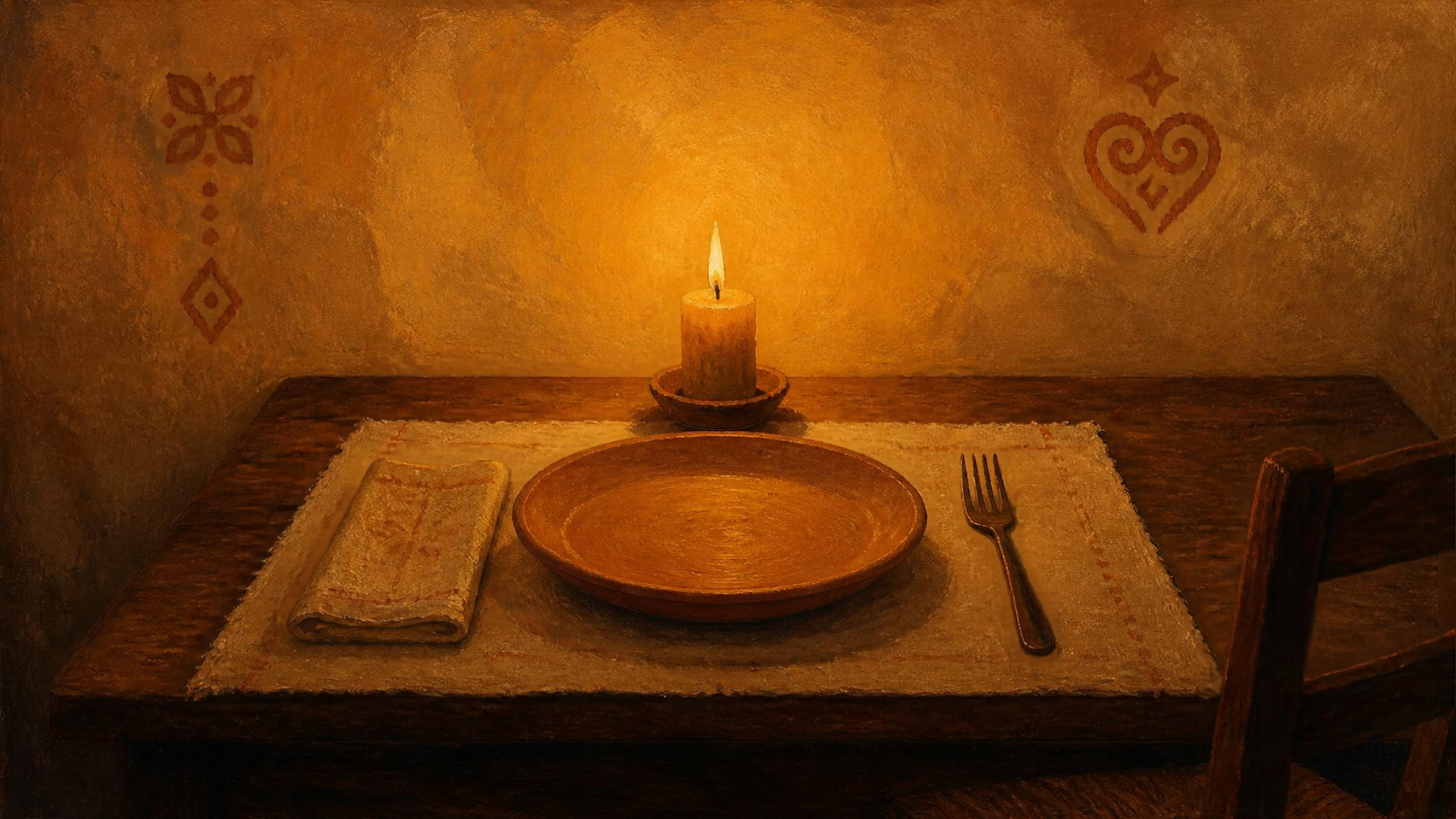
So you arrive somewhere new, and the table is bare. And the real work of migration — the part under the paperwork, under the packing list — is learning to set it again.
What you’re really building
Liberation is not just a destination. It is a lineage — something we reclaim for ourselves and then pass forward, the way it was once passed to us by people who crossed harder ground than an international flight. The cimarrones who refused bondage did not just free themselves. They built new worlds, together, from ancestral memory and whatever they had in their hands. That is the spirit that moves through every table you build from here on. You are not starting from nothing. You are continuing something.
Home was never just a place. It is a feeling — safety, sovereignty, spiritual alignment — and feelings are built the same way tables are: one chair, one guest, one shared meal at a time. You do not find your people in Mexico by waiting for them to find you. You find them by showing up, again and again, to the rooms where they already are — and by becoming, yourself, a room someone else can walk into.
Grief and gathering, held together
Here is the truth nobody puts on the welcome packet: you will grieve the old table even as you set the new one. Both things are happening in your body at once. The ache for who you left, and the hunger for who you’ll gather. The silence of an empty chair, and the sound of a new friend’s laugh filling your kitchen for the first time. Migration is healing — but healing was never a straight line, and it was never supposed to erase what came before it. Rest is sacred practice. Memory is mortar. You build with both hands: one holding the grief, one setting the table.
A woman in a recent documentary about Black Americans living in Mexico put it plainly: *”Our skin color makes us feel hypervisible. But at the same time, Mexico is a place where many of us come to feel truly seen.”* Hypervisible and truly seen, in the same breath, in the same body. That is not a contradiction. That is what it actually feels like to be gathered somewhere new.
You are not building this alone
Your journey is your own. Your path is unique. But you do not walk it alone — and neither does your table stay bare forever. Somewhere near you, right now, someone else is setting down the same grief, carrying the same hunger, looking for the same chair to pull up next to yours. Whether you are still deciding — still weighing the whisper that brought you to this page — or already three years into a life you built with your own hands, the table is the same work. Find the rooms. Walk in. Bring something to share. Stay long enough to be known.
Audre Lorde once said it was in Mexico that she stopped feeling invisible. That is not a small thing to say. That is a table being set, one woman at a time, across generations — her table, feeding into yours, feeding into the one your own people will set after you.
So set a place. Not for the table you left — for the one you’re building. Pull up a chair. Call someone’s name. And when they sit down, ancestors and all, know that you are not improvising this from nothing. You are home.

Leave a Reply
You must be logged in to post a comment.